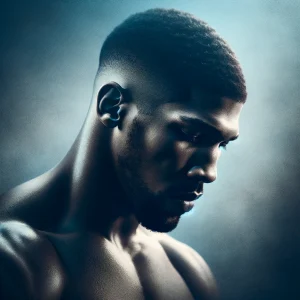
 Boxing fans around the world are surely excited for the upcoming clash between former UFC Heavyweight Champion Francis Ngannou and boxing heavyweight giant Anthony Joshua. The ten round fight takes place on March 8th in the Kingdom Arena, Riyadh, Saudi Arabia. Following on from the unpredictable yet captivating match-up between Ngannou and Tyson Fury (which proved to be anything but a joke fight), this bout again blurs the lines between MMA and boxing worlds as we all try to deduce who is likely to claim victory. But the million-dollar question remains: Can Francis Ngannou, with his MMA background, take down a world class boxing heavyweight like Anthony Joshua?
The Ngannou Effect
Francis Ngannou is not your average MMA fighter. Known for his devastating power and ferocious knockouts in the UFC, Ngannou has proven time and again that he’s a force to be reckoned with. His transition from the Octagon to the boxing ring could barely have started better. – if not for the judges deciding against him in a highly contested decision. The man carries immense one punch power. But boxing is a different beast. Precision, timing, and footwork play a much larger role than MMA, where skills on the canvas play a pivotal role also. So can Ngannou’s power combine with an ability to adapt to a new sport?
Against All Odds: The Tyson Fury Benchmark
Ngannou’s performance against Tyson Fury offers a glimpse of what the Cameroonian is capable of in a boxing ring. While direct comparisons are tricky due to the nature of their exhibition match, Ngannou’s ability to hold his own against Fury, one of boxing’s finest, is telling. It was a statement that an MMA fighter could step into the ring and not just survive but thrive. This performance has set a precedent, but Anthony Joshua is a different challenge altogether.
“I will do something that no-one has done before and I believe I have the tools to do that, starting with having the win over ‘AJ’ on March 8 in a big fight – not an easy fight, but a possible one and I am going to take it.” is The ‘Predator’s’ grounded yet positive take on the AJ fight.
Anthony Joshua: Last Chance Saloon
Anthony Joshua is no stranger to the spotlight. With a professional record that boasts significant victories (Wladimir Klitschko, Andy Ruiz Jr rematch) as well as setbacks (Oleksandr Usyk x 2), Joshua’s experience in high-stakes boxing matches is significant. Joshua, like Nnganou an orthodox fighter, has a record of 27 wins from 30 fights (24 wins by knockout). He’s 6ft 6 with a 82 inch reach. His power and resilience make him a formidable opponent for anyone, let alone someone transitioning from MMA. Possible shortcomings though include his mindset, questions over his stamina and also his patchy form. Many see this as a potential route back to becoming World Champion and his eye is certainly on the prize.
“Every fight leads to somewhere, so this fight is my everything; my soul, my spirit, my mind, my body.” says AJ, of the Ngannou bout.
If he loses though, especially against a ‘non boxer’ does he have anywhere left to go?
The Clash of Titans: What to Expect
6ft4 Ngannou brings serious punch power and an unquestionable fighting spirit. With a UFC record of 17-3-0 (12 wins by KO) and a 83 inch reach he certainly has the tools to do the job. However, Joshua’s experience in the ring surely poses big challenges for Ngannou. Both fighters have different skillsets. Ngannou can close the distance as he did against Fury and unleash his one punch power, while Joshua will try to use his long reach and jab effectively, and exploit any openings. Let’s not forget AJ also has immense power.
Francis Ngannou taking on Anthony Joshua is a fascinating and curious chapter in combat sports. Ngannou’s performance against Tyson Fury has already shattered expectations, showing that with the right mindet and preparation, MMA fighters can make it in boxing despite having no background in the sport. However, overcoming a fighter with the experience of AJ requires not just power but also a winning strategy. At least that’s what the theory says anyway!
So who wins?
Can Francis Ngannou beat Anthony Joshua? The answer lies in preparation, followed by execution on the night of the fight. Ngannou’s power is definitely a significant factor, but Joshua’s boxing acumen presents a monumental challenge. As the fight night approaches, the fight fans will be watching, eager to witness history in the making. Bookmakers have AJ as the 1-4 favourite at time of writing, but if Ngannou defies expectations, it certainly wouldn’t be for the first time.
 The first thing to say about the longest field goal, or field goals, in NFL history is that, for reasons that will become obvious, the patron saint of placekickers, if one exists, appears to have it in for the Detroit Lions.
 Nowadays, the term ‘major championships’ is used to describe the Masters Tournament, the US Open Championship, the Open Championship and the PGA Championship. Exactly when the modern definition was adopted is unclear, but it can certainly be traced back to 1960, the year in which Arnold Palmer won the Masters Tournament and the US Open Championship, finished runner-up, by a single stroke, in the Open Championship and held the first-round lead in the PGA Championship before eventually finishing tied for seventh.