The tale of Rubio: The first American-bred Grand National winner
There have been some remarkable Grand National success stories in the history of thoroughbred horse racing, but the story of Rubio is one of the most important for the American industry. The winner of Aintree’s iconic Grand National steeplechase in 1908, Rubio set the bar high for US-bred steeplechasers. The story behind the success of Rubio is an equally fascinating one.
Rubio’s development
It all began for Rubio stateside under breeder J.B. Haggin. Mr Haggin had a string of promising horses in his Californian stud farm and opted to send Rubio to Newmarket’s selling auctions, given that it was – and still is – the spiritual home of horse racing. The feeling within the Haggin’s stud was that Rubio had strong potential to run well during the British flat racing season.
Rubio’s breeding meant that he certainly came from good stock, with Star Ruby being his sire who was a former racehorse owned by the Duke of Westminster with nine career wins to its name. Eventually, Rubio was snapped up for the princely sum of 15 guineas by a Northamptonshire-based horse dealer called Septimus Clarke. As a successful trader of thoroughbreds, Mr Clarke had no intention of developing Rubio and instead promptly sold him on to Major Frank Douglas-Pennant for 95 guineas, making a handsome 80 guineas profit in the process.
Aged four, Rubio was typically used for hunts, but it was quickly acknowledged that he had plenty of pace left in the tank and had a placid personality ripe for horse racing. Mr Douglas-Pennant tried to sell Rubio as a prospective thoroughbred but his reserve price was never met, so he pursued with him instead. High-end trainer Brian Bletsoe was employed to train Rubio. However, it got to the point that Rubio had weakened so much that he was deployed to pull trolley buses to try and rebuild the strength in his legs. Fortunately, the training regime helped Rubio regain his physical attributes to the point that he was entered into races in 1907.
With one win in three races around Towcester, it was hardly a ringing endorsement of Rubio’s potential. That’s why, in 1908, Rubio was priced as a huge 66/1 outside for the Grand National. Stable mate Mattie Macgregor was deemed to be a much more durable and reliable thoroughbred. Trainer Bernard Bletsoe even allowed his son Bryan to take the ride of Rubio around Aintree. Sure enough, Bletsoe and Rubio would shock the nation by storming to an unprecedented victory by ten clear lengths.
Sergeant Murphy was the next US-bred horse to become a Grand National winner in 1923. In doing so, Sergeant Murphy became the joint-second oldest thoroughbred to win the race aged 13 and this is still the case today.
Why the Grand National remains such an important event worldwide
The Grand National is still the most iconic and valuable steeplechase event in European horse racing. Not only does it carry a hefty prize purse it’s also ingrained in British culture. For many, it’s the one time of the year they place bets with bookmakers.
Although the Grand National is one of the most popular UK horse races to bet on, it’s also one of the hardest to pick a winner. There is so much to consider, given the number of runners and riders, the going of the turf and the age of the horses too. In general, betting on horse racing requires a strategic mindset, so if you know how to play games like poker, you probably already have some of the skills required to make intelligent bets.
With an estimated viewer base of 500-600 million from more than 140 nations, it’s clear it captures the imagination worldwide. Had Rubio managed to upset all the odds in the 21st century, it would have been a tale that hit all the back pages across the globe. Instead, Rubio will be consigned to the record books forever as the first US-born Grand National winner – the first to pass the “ultimate test of horse and rider”.
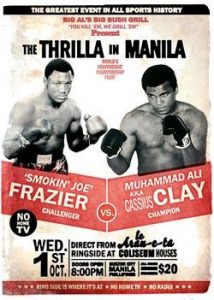 For those uninitiated, the bout billed as the ‘Thrilla in Manila’ was a trilogy fight between Muhammad Ali and ‘Smokin” Joe Frazier staged in Metropolitan Manila, the National Capital Region of the Phillipines, on October 1, 1975. It is almost universally regarded as one of the greatest, and most unrelenting, fights in boxing history. Incidentally, the catchphrase was derived from a line of trash talk delivered in the build-up to the fight; he said, ‘It’s gonna be a chilla, and a killa, and a thrilla, when I fight the Gorilla in Manila.’
 When it comes to making smart bets and minimizing your risk of losing money, the most important thing to remember is that there is always a thing called